Multi-Domain Operations (MDO)
Operating in a networked manner
More than 100 years ago, drawing on the experiences of the First World War, the Army described the combined action of different branches of the armed forces – such as armoured units, armoured infantry and support units – under the military tactical and command concept of ‘combined arms combat’. ‘Joint Operations’ traditionally refers to the joint action of different branches of the armed forces. The focus is on the organisational and operational cooperation of military forces. Each branch contributes its capabilities; coordination is carried out jointly, but the operations of the various branch contingents are largely conducted in parallel.
‘Multi-Domain Operations’ go a step further. The focus here is not primarily on cooperation between organisational units, but on the integrated impact across multiple domains. Decisions, sensors, communications and effects are networked across domains and deployed as simultaneously as possible. The aim is to cause problems for the adversary in several areas at once and thereby achieve a superior tempo of operations. Particularly in modern conflict scenarios, civilian sectors are playing an increasingly important role, even if they are not ‘officially’ defined as a separate dimension – especially in cyber operations, disinformation, space infrastructure or hybrid conflicts, where the boundaries between military and civilian domains are becoming blurred.
A definition might read as follows:
Multi-Domain Operations (MDO)
Prerequisites
In order to conduct multi-domain operations efficiently and effectively, far more is required than just modern weapon systems. The key lies in the ability to link information, decisions and effects across different domains in a rapid and coordinated manner.
A number of key prerequisites appear to be central to this:

Shared situational picture

Networked Command and Communication Systems

Interoperability

Rapid decision-making cycles

Cross-dimensional planning

Highly qualified staff

Resilience and redundancy

Integration of civilian capabilities

Data and information superiority
Multi-Domain Operations (MDO)
The ‘system of systems’ approach
Technological superiority is a key component in the effective implementation of multi-domain operations. Coordinated command, reconnaissance, engagement and support of all forces across all domains must be underpinned by systems capable of providing cross-domain connectivity, speed, integration and resilience.
The term ‘system of systems’ refers to a network of autonomous, interconnected systems which, through shared data, communication and command structures, function as an integrated whole, thereby generating capabilities that individual systems could not achieve in isolation.
Against the backdrop of modern multi-domain operations, technical superiority no longer arises primarily from the performance of a single device or weapon system, but from the quality of the interconnection between sensors, effectors, and command, communication and information systems. The decisive factor is how quickly information can be collected, processed, distributed and translated into coordinated action.
IBM’s approach is characterised in particular by four features:

Tried and tested
Connected, air-supported operations via a secure cloud (luWES)
At present, the armed forces have no airborne capabilities for joint operations within the electromagnetic spectrum. However, unrestricted freedom of movement for their own forces in airspace is essential for joint air warfare operations.
For the luWES programme, IBM has developed the architecture for a ‘system of systems’ based on cloud technology. An initial prototype Electromagnetic Warfare Cloud (EW Cloud) was presented to representatives of the requirements-defining and user organisations from the Bundeswehr and the Federal Ministry of Defence (BMVg) during a practical trial.
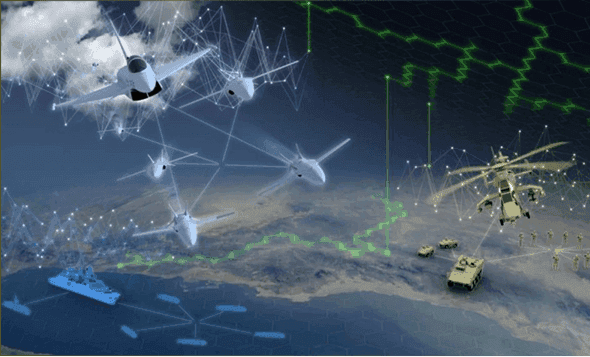
Architectural approach
Multi-Domain Operations via an open core architecture (MDOCore)
A system of systems for modern multi-domain operations requires a core digital architecture. It must integrate sensors, effectors and command and information systems across all domains.
This is precisely where MDOCore comes in: with real-time networking, semantic data access directly at the sensor, data fusion, and AI-supported analysis and decision support. Resilient interoperability links military and supporting civilian systems. Thanks to its open architecture, MDOCore can be expanded modularly and adapted quickly.